
MOVEMENT IS MEDICINE After a Total Joint Replacement
Total Knee Arthroplasty (TKA)
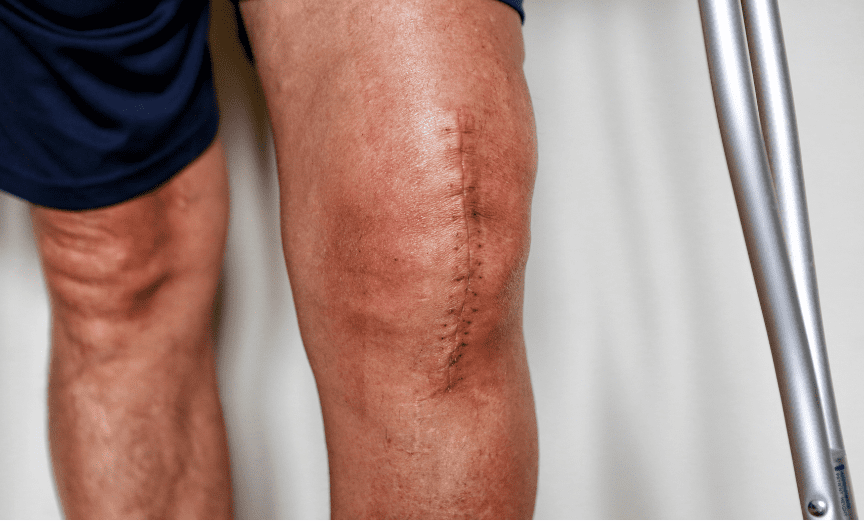
A total knee replacement is a procedure where a surgeon replaces a painful knee joint with an artificial joint to reduce pain.
A common misconception following a total knee joint replacement surgery is to rest. However, this is not the best practice if you want your knee to regain mobility. Often after surgery there is a lot of swelling, stiffness and pain which limits your knee’s motion. The best way to regain your mobility is to begin moving it in both directions IMMEDIATELY.
Once an hour you should get up to walk around on your knee, despite the stiffness you feel.
Once an hour you should bend your knee for 20-30 repetitions and straighten your knee for 20-30 repetitions to regain motion.
To control pain, take prescribed medication as well as ice 3-5 times a day for 15- 20 minutes.
To control swelling, wear a compression garment and elevate your leg PAST your heart.
Remember, to get a new knee, the surgeon had to cut through bone, which is painful, but only temporary! Your pain WILL get better in a few weeks, just keep MOVING!
Initiate physical therapy at Apex Physical Therapy and Wellness to work with a therapist to get your knee pain free and you back to your normal activities!
Total Hip Arthroplasty ( THA)
Total Hip Arthroplasty is a procedure where a surgeon replaces a painful hip joint with an artificial joint to reduce pain. There are different approaches a surgeon can utilize depending on a patient’s need. The two most common approaches are an anterior approach where the surgeon goes through the front of the hip to replace the joint or a posterior approach where the surgeon goes through the back of the hip to replace the joint.
Anterior Approach
The first 6 weeks following your total hip replacement there are precautions you must follow to prevent your hip from dislocating. Those hip precautions include:
| Precautions | Functional Activities to AVOID |
| No forceful hip extension | No kicking your leg backwards |
| No hip external rotation past neutral | Do not put your ankle up onto you other leg, no twisting/pivoting on your leg |
Posterior Approach
The first 6 weeks following your total hip replacement there a precautions you must follow in order to prevent your hip from dislocating. Those hip precautions include:
| Precautions | Functional Activities to AVOID |
| No hip flexion past 90 degrees | Be careful when sitting up in bed, bending over to put shoes on, bending over to put pants on, etc. |
| No crossing you leg | Sitting with one leg over the other |
| No internal rotation on your surgical leg | No twisting or pivoting on your leg |
It is important to follow these precautions to prevent your new hip from dislocating while it heals. Initiate physical therapy at Apex Physical Therapy and Wellness one week after your surgery and a physical therapist will work on safe mobility, strength and overall function of your new hip.