
Why Pain Does Not Always Mean Tissue Injury
Many people are surprised to learn that pain doesn’t always come from damaged tissue. One of the clearest examples of this is phantom pain—pain that feels very real, even though the body part itself is no longer present or is no longer sending normal signals.
Understanding phantom pain helps explain how the brain processes pain—and why physical therapy can play a powerful role in calming it.
What Is Phantom Pain?
Phantom pain most commonly occurs after an amputation, but it can also happen after nerve injuries, spinal cord injuries, or prolonged immobilization. People may feel pain, tingling, cramping, or burning in a limb that is no longer there or no longer moving normally.
This pain is not imagined. It is the result of how the brain and nervous system interpret sensory information.
Phantom pain clearly shows that pain does not require ongoing tissue damage to exist.
The Brain’s Body Map
Your brain contains a detailed internal “map” of your body, often called the body map (or homunculus). Each body part has a specific area in the brain responsible for processing sensation and movement.
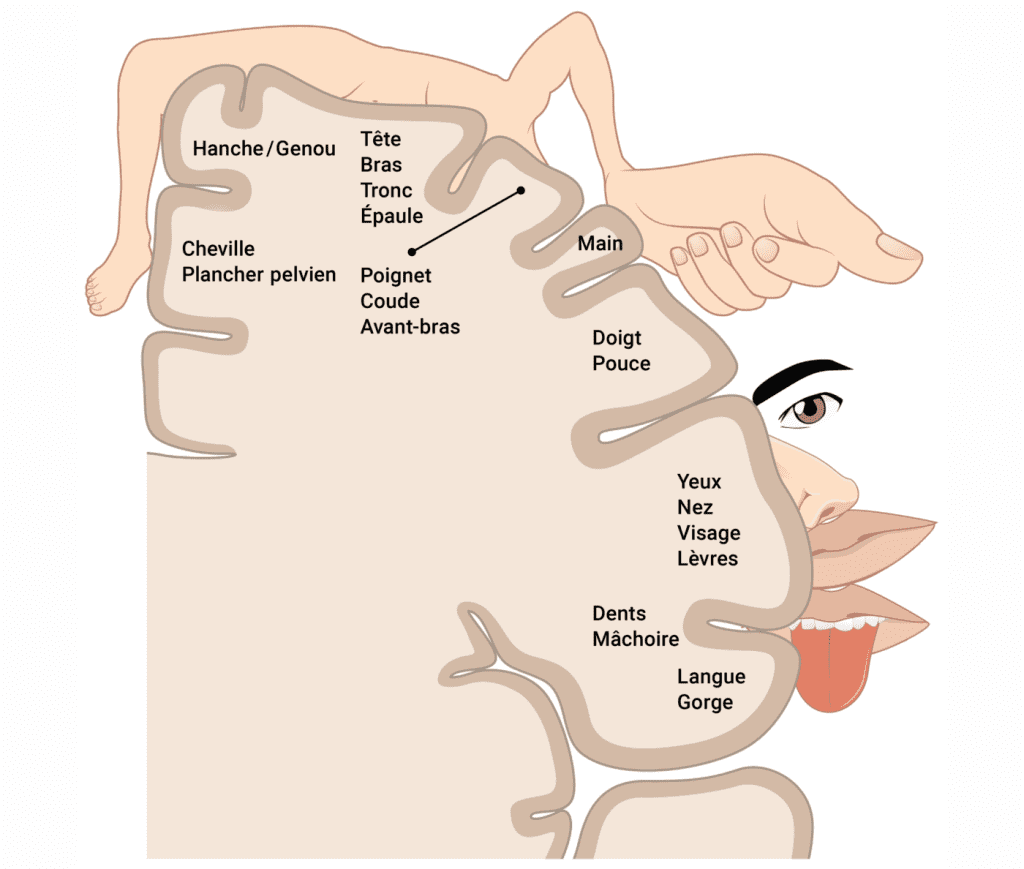
When a limb is injured, immobilized, or amputated:
- The brain’s map does not immediately update
- The area representing that body part can become confused or overactive
- Nearby brain regions may begin to overlap or “invade” that space
This mismatch between what the brain expects and what it receives from the body can result in pain—even when tissues are healed or no longer present.
Why Does Phantom Pain Hurt So Much?
Phantom pain often feels intense because:
- The nervous system becomes overprotective
- The brain interprets missing or altered signals as a threat
- Pain pathways become more sensitive over time
In simple terms, the brain is trying to protect you—but it’s working with outdated or unclear information.
How Mirror Therapy Helps
Mirror therapy is a technique that helps retrain the brain’s body map using the sensory system.
By placing a mirror so the reflection of the intact limb appears where the affected limb would be, the brain receives clear visual input that the limb is present and moving normally.
This can:
- Restore a clearer body map
- Reduce the brain’s threat response
- Decrease pain intensity over time
- Improve confidence with movement
The brain responds strongly to visual and sensory input, making mirror therapy a powerful, low-risk way to help calm the nervous system.
Why This Matters Beyond Phantom Pain
Phantom pain helps illustrate an important truth about all pain:
pain is produced by the nervous system, not simply by injured tissues.
Even when pain feels very physical, the brain is constantly interpreting:
- Sensory input from the body
- Past injuries or experiences
- Visual information
- Emotions, stress, and expectations
When the nervous system decides something feels unsafe, it produces pain as a protective response. This is helpful during acute injury—but when that protection stays turned on too long, pain can persist even after tissues have healed.
This is why people may experience:
- Ongoing pain with “normal” imaging
- Pain that moves, changes, or flares unpredictably
- Pain that feels disproportionate to activity
- Pain that lasts months or years after injury or surgery
In these cases, the nervous system has often become sensitized or overprotective.
Phantom Pain Is One Example of a Bigger Pattern
Phantom pain is a clear and dramatic example of the nervous system’s role in pain, but similar processes occur in many chronic pain conditions.
In chronic pain:
- The brain’s body map may become unclear or distorted
- Pain pathways become more sensitive
- The nervous system learns to associate movement or positions with threat
- Pain can exist without ongoing tissue damage
This does not mean pain is “in your head.” It means the nervous system is doing exactly what it was designed to do—protect—just a bit too well.
Why Physical Therapy Matters for Nervous System–Driven Pain
Many people think physical therapy only treats muscles and joints. In reality, modern physical therapy plays a key role in retraining the nervous system and sensory system.
Physical therapists help by:
- Providing safe, graded movement to show the nervous system that motion is not dangerous
- Using sensory input (touch, movement, visual feedback) to sharpen the brain’s body map
- Educating patients about how pain works, which can reduce nervous system threat
- Reducing fear and avoidance behaviors that reinforce pain pathways
- Gradually restoring confidence in movement
This process helps the nervous system turn down its alarm system.
How Physical Therapy Helps “Rewire” Pain Pathways
Physical therapy does not aim to push through pain. Instead, it works to:
- Expose the nervous system to movement in a controlled, safe way
- Build tolerance rather than provoke flare-ups
- Normalize sensory and motor signals to the brain
- Improve predictability and trust in the body
Over time, this can:
- Reduce pain intensity
- Decrease flare-ups
- Improve function and quality of life
- Restore confidence in movement
Pain can change when the nervous system learns it no longer needs to protect as aggressively.
The Takeaway
Phantom pain shows us that pain can exist without tissue damage. Mirror therapy shows us that changing sensory input can change pain. Chronic pain often follows the same rules.
When pain persists, the nervous system—not the body part—may be driving the experience. Physical therapy helps retrain how the nervous system interprets movement, sensation, and safety.
With the right guidance, the brain can adapt—and pain can change.
Ready to Learn More?
If you are experiencing persistent pain, numbness, or unusual sensations after injury or surgery, working with a physical therapist trained in nervous system–informed care may help.
Physical therapy isn’t just about treating tissues—it’s about helping your nervous system feel safe in your body again.